
Past life regression is a guided session, usually using hypnosis, in which a practitioner leads you to recall what feel like memories of earlier lives. People try it for spiritual insight or to explore recurring fears and patterns. Research shows these “memories” are built from imagination, things you’ve forgotten you knew and the guide’s suggestions, so it’s best treated as a meaningful inner experience: not proof of a past life, and not a treatment for any condition.
Below: what happens in a session, what psychologists have found, the risks, and how to choose a practitioner. If you’re drawn to the idea because of patterns that seem older than this life, the ideas behind it are covered in our guide to past life karma and how to clear it.
What Happens in a Past Life Regression Session?
A session is a guided relaxation followed by a series of questions about scenes that come to mind. Practitioners vary, but most follow the same broad steps that Cleveland Clinic describes for hypnosis: induction, deepening, suggestion and emergence.
- A conversation first. The practitioner asks what you hope to explore, your health, and whether you’ve been hypnotized before.
- Induction. You lie or sit comfortably while they guide your breathing and attention, often relaxing your body muscle by muscle.
- Deepening. Imagery takes you further in: walking down a staircase, drifting down a river, passing through a corridor of doors.
- The crossing. You’re asked to step through a door or into a light and notice where you are. Some practitioners first take you back through your own childhood, then “before birth.”
- Exploring. The practitioner asks questions: look at your feet, what are you wearing, what is your name, where are you, who is with you? Scenes may move to an important day or to the end of that life.
- Coming back. You’re guided up the stairs or back through the door, then gently brought to full alertness.
- Talking it over. A good practitioner helps you make sense of what came up without telling you what it “means.”
You don’t fall asleep or lose control. Most people remain aware of the room and remember the session afterward. What comes up is often more like a daydream or a film playing in the mind than a sharp memory: fragments of images, a feeling in the body, a sense of “knowing.” Some people see nothing at all.
Where Does Past Life Regression Come From?
Remembering past lives is an old spiritual aim, but regression by hypnosis is a 20th-century practice. According to the history of past life regression, Patañjali’s Yoga Sutras discuss impressions carried over from earlier lives, and Jain practice includes jati-smaran, the remembering of former births. In 1923 the American psychic Edgar Cayce spoke in trance about a questioner’s past lives, and the use of hypnosis for regression is credited to A. R. Martin, who published Researches in Reincarnation and Beyond in 1942.
The practice went mainstream in the 1950s with the Bridey Murphy case. In 1952 an amateur hypnotist, Morey Bernstein, regressed Virginia Tighe, a homemaker in Pueblo, Colorado, who spoke in an Irish brogue as Bridey Murphy, a woman born in Cork in 1798. His 1956 book The Search for Bridey Murphy became a bestseller. A second wave came from the psychiatrist Brian Weiss, whose book Many Lives, Many Masters describes a patient recalling past lives under hypnosis. Later methods built on the same idea, including Dolores Cannon’s Quantum Healing Hypnosis Technique; how it compares with its offshoot is set out in BQH vs QHHT: the difference explained.
All of these rest on a belief in reincarnation: that a soul returns through many lives, carrying lessons between them, as described in our guide to the soul’s journey and its stages.
Is Past Life Regression Real? What the Evidence Says
The experiences are real, but there is no good evidence that they are memories of past lives. Psychologists who have tested regression find that the content follows what the person believes and what the hypnotist suggests.
Suggestion shapes the story. In a series of experiments at Carleton University in Canada, the psychologist Nicholas Spanos and colleagues regressed volunteers and found that the past-life identities they produced matched what the hypnotist had led them to expect. Across such studies, belief in reincarnation and the hypnotist’s suggestions were the strongest predictors of what people “remembered,” as the research summary on past life regression sets out.
Forgotten sources resurface. The mind can replay things you once read, heard or saw without recognizing them as memories, a process called cryptomnesia. Bridey Murphy is the classic case: investigators found that an Irish immigrant named Bridie Murphy Corkell had lived across the street from Tighe’s childhood home in Chicago, that Tighe’s parents were partly Irish, and that she had used an Irish brogue in plays as a teenager. Many details of “Bridey’s” life matched her own childhood.
Hypnosis doesn’t sharpen memory. In a study presented at the American Psychological Association’s 2001 meeting, hypnotized students were no more accurate at dating real news events than students who had simply relaxed, and they were less willing to correct answers they’d been warned might be wrong. The researchers concluded that memories recovered under hypnosis need to be confirmed by other means before they’re accepted as true.
Even reincarnation researchers are wary. The University of Virginia’s Division of Perceptual Studies, which has spent decades collecting cases of young children who speak of past lives, has never used hypnosis in that work. Its founder, Ian Stevenson, wrote that nearly all hypnotically evoked “previous personalities” are entirely imaginary, that strong emotion during a session is no sign the memory is genuine, and that feeling better afterward doesn’t show a past life was recalled, since many kinds of therapy bring general benefits.
What Do Doctors and Psychologists Say About It?
Mainstream mental health professions don’t accept past life regression as a treatment. A 2006 survey of doctoral-level mental health professionals, cited in the overview of past life regression, found that most rated past lives therapy as “certainly discredited” for treating mental or behavioral disorders, and the practice is widely rejected by clinical psychiatrists and psychologists.
Professional bodies have also warned about memory recovery techniques in general, a group that includes hypnosis, age regression and past life regression. According to a summary of positions on recovered-memory therapy, the UK’s Royal College of Psychiatrists advised psychiatrists to avoid such techniques because nothing supports the accuracy of memories recovered that way, and the Canadian Psychological Association urges psychologists to be cautious with hypnosis and age regression.
Hypnosis itself is a different matter. Cleveland Clinic counts it as a complementary therapy that may help with stress, anxiety, pain and habits such as smoking when used alongside usual care. That support is for hypnosis aimed at present-day symptoms, not for travel to past lives, and no evidence shows that regression cures phobias, illness or trauma.
Is Past Life Regression Safe?
For most people a session is a calm, uneventful experience, but it carries real risks that practitioners rarely mention:
- False memories. Scenes created under suggestion can feel exactly like real memories afterward, and you may go on believing them.
- Distress. Death scenes, violence or grief can surface. Cleveland Clinic lists increased anxiety, headaches, dizziness and trouble sleeping among the rare after-effects of hypnosis.
- Not quite coming back. Stevenson recorded rare cases in which a past-life persona lingered and left the person in an altered state for several days.
- Memories about this life. Regression can drift into childhood. “Recovered” memories of abuse produced this way have led to false accusations against family members, which is why professional bodies warn against these techniques.
- Delayed treatment. Explaining anxiety, depression or pain as a past-life wound can keep you from care that works.
- Money. Watch for packages of many sessions, or a practitioner who says your problems need more and more regressions to clear.
If you live with trauma, dissociation, psychosis or another mental health condition, talk to your doctor or therapist before booking. If a session leaves you shaken for more than a day or two, or you’re having thoughts of harming yourself, contact your doctor; in the US you can call or text 988 at any hour.
How Do You Choose a Past Life Regression Practitioner?
Choose someone who treats your experience as yours to interpret and who would tell you if regression isn’t right for you. Cleveland Clinic’s advice for any hypnotherapist is to look for a professional licensed in a health field such as medicine, psychology, social work or nursing, with extra training in hypnosis. A certificate from a regression school is not a health license, so ask what lies behind the letters.
Good signs:
- They ask about your health and mental health history before the session
- They use open questions (“What do you notice?”) rather than leading ones (“Can you see the battlefield?”)
- They explain how they’ll help if strong emotion comes up, and how you can stop at any time
- They let you record the session
- They’re honest that what comes up may be imagination as much as memory
Walk away from anyone who promises to heal an illness or phobia, guarantees you’ll see a past life, tells you who you were before the session starts, suggests you stop medication or therapy, or pushes a costly series of sessions.
Before you book, Stevenson suggested asking yourself one question: if you did remember a past life, how would it help with what you’re facing now? If the answer is a sense of curiosity or meaning, regression may be worth trying. If you hope it will fix a problem, a qualified therapist is the better first step.
Can You Do Past Life Regression on Your Own?
Yes, many people use guided recordings or meditation at home, and some practitioners teach self-regression. It’s gentler than a live session because no one is asking leading questions, though the same limits apply: what you see is shaped by what you expect.
- Choose a quiet time when you won’t be driving or working afterward
- Use a recording with a clear return at the end
- Write down what came up straight away, then ask what it says about your life now rather than whether it was “true”
- Stop if it becomes upsetting, and don’t use it to dig for memories of your own childhood
People drawn to past lives often recognize themselves in descriptions of an old soul, and teachers often tie the patterns people notice back to past life karma.
Past Life Regression FAQ
What does past life regression feel like?
Most people describe deep relaxation, a heavy or floating body and a drifting mind, much like the moments before sleep. Images tend to arrive in flashes rather than as a continuous film, sometimes with a strong emotion or a physical sensation, such as cold or the weight of clothing. You can usually hear the practitioner and the room around you throughout, and you can open your eyes whenever you want.
Can you get stuck in a past life?
Not in any literal sense: you can open your eyes and end a session whenever you choose. What can happen, rarely, is that feelings from the session linger as low mood, unease or vivid dreams for a few days. Rest, talk it through with the practitioner and see your doctor if it doesn’t pass.
How long does a session take?
Expect longer than a standard hypnotherapy appointment, which Cleveland Clinic puts at about an hour. Regression sessions add an opening conversation and time to talk afterward, and methods such as QHHT can run for several hours. Ask for the full length and price before you book.
How is a regression different from a past life reading?
In a regression, you are guided into a relaxed state and describe what you experience yourself. In a past life reading, a psychic, medium or astrologer tells you about your past lives, so the story comes from them rather than from you. Neither can be verified, but a regression at least leaves the interpretation in your hands.
Do you have to believe in reincarnation for it to work?
No, though belief makes a vivid “past life” more likely, according to the experiments described above. Some people go in as skeptics and value the session as guided imagination, a way to see current feelings from a new angle. It’s worth knowing what you want from it before you start: insight and curiosity are realistic goals; proof is not.
Sources
- Hypnosis, Cleveland Clinic
- Concerns About Hypnotic Regression, Division of Perceptual Studies, University of Virginia School of Medicine
- Hypnosis May Give False Confidence in Inaccurate Memories, The Ohio State University, 2001
- Past life regression, Wikipedia
- Recovered-memory therapy, Wikipedia
- Bridey Murphy, Wikipedia
- Cryptomnesia, Wikipedia
- Brian Weiss, Wikipedia
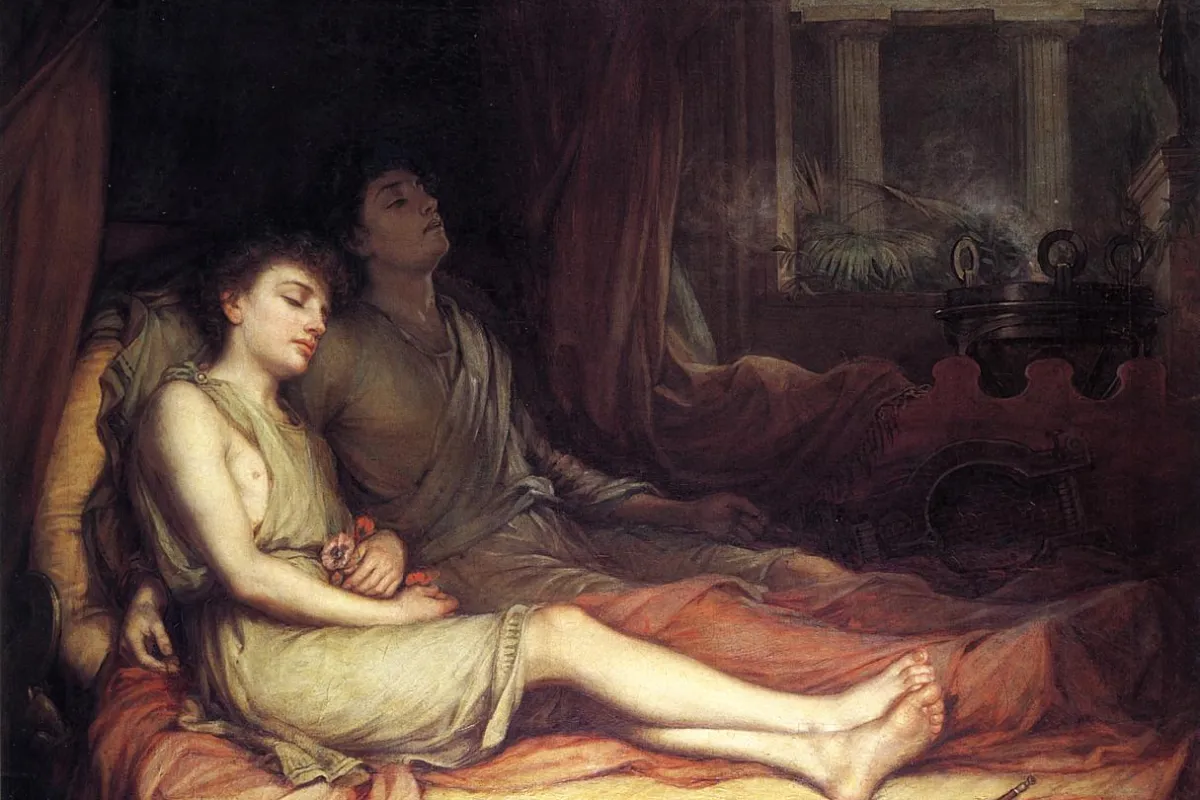
Image: Sleep and His Half-Brother Death, John William Waterhouse, 1874. Public domain, via Wikimedia Commons.

