
The law of attraction says your thoughts and feelings send out a signal that draws matching experiences to you, so you focus on what you want and let the universe bring it. The law of assumption, taught by mystic Neville Goddard (1905–1972), says nothing outside you is doing the attracting: you assume you already have what you want, live from that feeling, and your outer world is believed to rearrange itself to match. In short, attraction is about pulling a wish toward you, while assumption is about being the person who already has it.
Both are beliefs, not proven laws. Below is a side-by-side view, then what each teaches, how Neville’s methods work, and what psychology has found. If you are new to the wider idea, start with our guide to what the law of attraction is and how to use it.
Law of Assumption vs Law of Attraction at a Glance
The two overlap a lot, but they put the power in different places. Here is how they compare as their teachers describe them:
| Law of assumption | Law of attraction | |
|---|---|---|
| Where it comes from | Neville Goddard’s books and lectures, 1939–1972 | 19th-century New Thought writers, popularized in the 2000s |
| Core idea | What you assume to be true hardens into fact | Like attracts like: thoughts draw matching events |
| Where the power sits | Your imagination, which Neville equated with God | A universal law or energy you align with |
| Main tool | Feeling the wish already fulfilled | Focused positive thought and emotion |
| Typical practice | A short imagined scene in a drowsy state before sleep | Visualization, affirmations, vision boards, gratitude |
| Language | “I am,” “I have,” “it is done” | “I am attracting,” “I am open to receiving” |
| Doubt and setbacks | Ignore current facts; keep the assumption | Raise your vibration and watch for signs |
| Waiting | No asking or waiting: you already have it | Ask, believe, then receive in time |
The biggest difference is the first and third rows. Attraction keeps a gap between you and what you want, and asks you to close it. Assumption says the gap is the problem, and that you close it by living as though it is already gone.
What Is the Law of Assumption?
The law of assumption is the belief that whatever you accept as true about yourself and your life, and keep accepting, becomes your reality. Its source is Neville Goddard, who published under his first name, Neville. According to Wikipedia’s biography of Neville Goddard, he was born in Barbados on February 19, 1905, moved to New York at 17 to study drama, and worked as a dancer before turning to metaphysics. Between 1929 and 1936 he studied with a teacher he called Abdullah, who taught him Kabbalah and a mystical reading of the Bible. He lectured until his death on October 1, 1972.
Neville wrote 14 short books and gave hundreds of lectures. The ones his readers return to most are:
- At Your Command (1939), his first book
- Your Faith Is Your Fortune (1941)
- Feeling Is the Secret (1944), a short book on feeling, sleep and the subconscious that most readers start with
- The Power of Awareness (1952)
- The Law and the Promise (1961), which pairs “the law” of imagining with his later mystical teaching
His central instruction was to “assume the feeling of the wish fulfilled.” He also wrote that “an assumption, though false, if persisted in, will harden into fact.” Neville taught that human imagination is what the Bible calls God, and that the outer world is a projection of your inner state. On that view, you are not asking anyone for anything. You are changing your own state, and the outer world is believed to follow.
What Is the Law of Attraction?
The law of attraction is the New Thought belief that positive or negative thoughts bring positive or negative experiences into your life. Wikipedia’s history of the law of attraction traces the phrase to the Spiritualist writer Andrew Jackson Davis in 1855, then to Prentice Mulford in the 1880s and William Walker Atkinson’s Thought Vibration or the Law of Attraction in the Thought World in 1906. It reached a mass audience a century later through self-help books and films.
Most modern teachers describe it in terms of energy: your thoughts and emotions carry a frequency, and life sends back experiences on the same frequency. That is why it sits so closely with the law of vibration, and why so much law of attraction advice is about lifting your mood. Our law of attraction guide covers its techniques in full, so this page sticks to how it differs from Neville’s approach.
What Is the Difference Between the Law of Assumption and the Law of Attraction?
The difference is where each one places the cause: the law of attraction points to a universal force that responds to you, while the law of assumption points to you alone. Four practical differences follow from that.
1. Who Does the Work
In the law of attraction, you send a request and the universe answers. In the law of assumption, there is no outside party. Neville taught that the outer world projects your inner state, so other people and events are thought to mirror your assumptions about them. Some find that freeing; others find it heavy, since it can sound as though every hardship is your fault.
2. Feeling Versus Thought
The law of attraction usually starts with thoughts: what you focus on, you get. Neville put feeling first. The title Feeling Is the Secret says it: a thought you repeat without feeling it as real does little, in his teaching, while a feeling of “it is done” does the work even if you rarely think about it.
3. Having Versus Wanting
A lot of law of attraction practice keeps you in the position of someone who wants: you list desires, picture them arriving and wait for signs. Neville taught that wanting confirms you don’t have it. His readers call the alternative “living in the end”: you think from the finished result, not toward it. Asking “How do I get the job?” is wanting. Quietly feeling what Monday morning at the new job is like is assuming.
4. Handling the Current Facts
Law of attraction teachers often say a bad mood or a worrying thought can attract more of the same, so they spend effort staying positive. Law of assumption practitioners tend to treat current circumstances as old news, a reflection of past assumptions that will change once the new one sets in. They aim to persist in the assumption whatever the evidence says, rather than to police every thought. Both camps say you still act in the world; for the law of attraction version of that idea, see the law of inspired action.
How Do You Practice the Law of Assumption?
You practice it by choosing what you want, imagining a short scene that would happen after you have it, and feeling that scene as real, most often while drifting toward sleep. Neville’s best-known method is what his modern readers call SATS, short for the “state akin to sleep”: the drowsy, half-dreaming state just before you fall asleep, when he believed an imagined scene passes most easily to the subconscious. A simple version looks like this:
- Choose one wish and state it as a result, such as “I live in my own apartment.”
- Pick a scene that implies it. Something that would only happen once the wish is real: opening your own front door, or a friend saying “I love your new place.”
- Relax in bed until your body feels heavy and your thoughts slow.
- Enter the scene from the inside. See it through your own eyes, not as a movie of yourself. Notice the key in your hand, the sound, the relief.
- Loop it until it feels natural, even a little ordinary, and let yourself fall asleep in that feeling.
Neville also taught “revision”: at the end of the day, you replay a moment that went badly and imagine it going the way you wished, so the day ends on the version you want. If you find it hard to reach the relaxed state, a calming practice such as this spiritual awakening meditation can help you settle first.
Which One Should You Use?
Use whichever matches how your mind works, and don’t worry about mixing them: many people do. A rough guide:
- The law of assumption may suit you if you like a quiet, inner practice, find vision boards and constant positivity tiring, or feel stuck in “waiting for the universe.”
- The law of attraction may suit you if you like gratitude lists, affirmations and noticing signs, or if the idea of a supportive universe gives you comfort that “it’s all you” does not.
- Either way, pair the inner work with real steps. Neither practice replaces applying for the job, saving the money or seeing a doctor.
Does Either One Actually Work?
There is no scientific evidence that thoughts, feelings or assumptions change outside events on their own. The law of attraction is widely described as pseudoscience, with support resting on personal stories that are open to confirmation bias, as Wikipedia’s article notes. The law of assumption makes the same kind of claim and has the same lack of evidence.
Two studies are worth knowing. In four experiments, psychologists Heather Barry Kappes and Gabriele Oettingen found that positive fantasies about an ideal future sapped people’s energy more than questioning, negative or neutral ones did, which may explain why dreamy fantasies go with poorer results. And a 2023 study of more than 1,000 people by Lucas Dixon and colleagues, “‘The Secret’ to Success? The Psychology of Belief in Manifestation”, found that people who strongly believed in manifesting rated themselves as more successful, yet were more likely to be drawn to risky investments and to have experienced bankruptcy. As the British Psychological Society’s summary notes, they were no more successful in income or education.
None of this rules out the calm and clarity people describe. The safest way to use either practice is as a way to steady yourself and get clear on what you want, followed by action and plans that allow for obstacles. And if “you created your reality” starts to sound like blame for illness, loss or someone else’s harm, put it down. No teaching is worth that.
Law of Assumption vs Law of Attraction FAQ
Who created the law of assumption?
Neville Goddard taught it from his first book in 1939 until his death in 1972, though he mostly called it simply “the law” and spoke of assuming the feeling of the wish fulfilled. The label “law of assumption” is how his later readers, and much of social media, came to name his method. Others in New Thought had similar ideas, but the specific practices people use today come from Neville.
Is the law of assumption more powerful than the law of attraction?
Many online teachers claim so, but there is no evidence that either one moves events, so there is nothing to compare. What differs is how they feel to practice. People who prefer assumption often say they feel less anxious because they stop checking for signs. People who prefer attraction often like the sense of a friendly universe on their side.
Can you use the law of assumption on a specific person?
“Specific person” manifesting is popular, but if someone has said no, ended things or stopped replying, respect it. Imagining them back can keep you stuck and, if it turns into contact they don’t want, can cross into harassment. Use the practice on how you want to feel in love and what you want in a partner, not on overriding another person’s choice.
How long does the law of assumption take to work?
Neville gave no fixed timeline. He taught that a persistent assumption comes about through a natural chain of events his readers call the “bridge of incidents,” so a wish might seem to arrive through ordinary means, such as a phone call or a chance meeting. Practitioners say constant checking shows you still assume you don’t have it, which is why they advise letting go of deadlines.
Can you use both at the same time?
Yes. Many people use a gratitude list or affirmations during the day and a Neville-style imagined scene at night. The two clash only on theory, about whether a universe is responding or you alone are the cause. In practice, both ask you to get clear on what you want and feel good about it, which is easy to combine.
Sources
- “Neville Goddard,” Wikipedia: en.wikipedia.org/wiki/Neville_Goddard
- “Law of attraction (New Thought),” Wikipedia: en.wikipedia.org/wiki/Law_of_attraction_(New_Thought)
- Kappes, H. B., and Oettingen, G. (2011). “Positive fantasies about idealized futures sap energy.” Journal of Experimental Social Psychology, 47(4), 719–729: doi.org/10.1016/j.jesp.2011.02.003
- Dixon, L., Hornsey, M. J., and Hartley, N. (2023). “‘The Secret’ to Success? The Psychology of Belief in Manifestation.” Personality and Social Psychology Bulletin: doi.org/10.1177/01461672231181162
- “Manifestation: Believe and achieve?” British Psychological Society Research Digest: www.bps.org.uk/research-digest/manifestation-believe-and-achieve
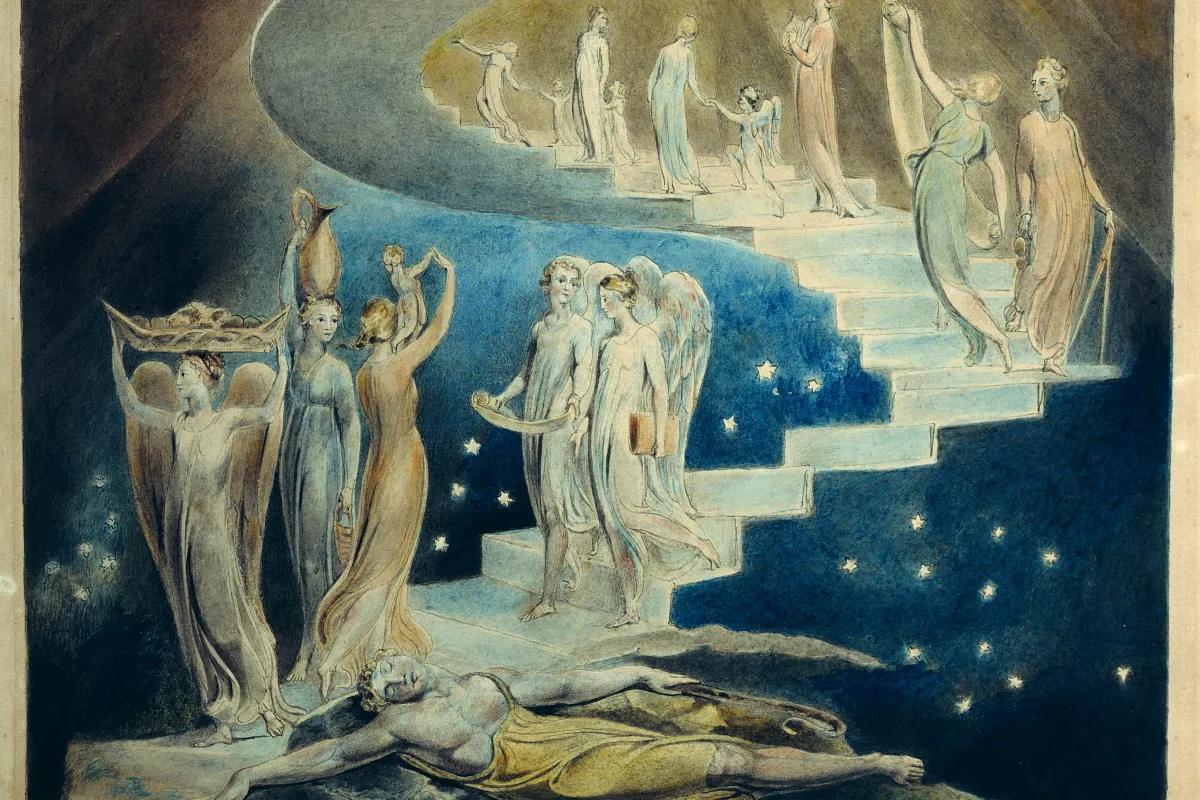
Image: Jacob’s Ladder, William Blake, c. 1805, British Museum, London. Public domain, via Wikimedia Commons.

